

Resources
Architectural Metal Coatings: A Primer for Architects
What AAMA 2603, 2604 and 2605 mean, how fluoropolymer coatings earn the top rating, and what to put in the spec for aluminum that has to last on the coast.
Exterior aluminum takes sun, salt, rain and pollution every day for decades, and the coating is what keeps it looking the way it was drawn. The simplest way to set that expectation in a spec is the AAMA performance level. For prominent work in a coastal climate, that usually means a fluoropolymer.
What are AAMA 2603, 2604 and 2605?
The American Architectural Manufacturers Association, now part of the Fenestration and Glazing Industry Alliance (FGIA), publishes three voluntary specifications for organic coatings on aluminum extrusions and panels. Each one sets lab tests for hardness, adhesion, impact and chemical resistance, plus outdoor weathering in South Florida, where sun and humidity are hardest on a finish.
| Spec | Performance level | South Florida exposure |
|---|---|---|
| AAMA 2603 | Pigmented organic coatings | 1 year |
| AAMA 2604 | High performanceCoastal Super-Durable | 5 years |
| AAMA 2605 | Superior performanceCoastal Fluoropolymer | 10 years |
After weathering, the test panels are measured for color change, gloss retention, chalking and erosion. Coastal Super-Durable meets AAMA 2604 with less than 5 ΔE of color change and at least 50% gloss retention after five years. Coastal Fluoropolymer is engineered to exceed AAMA 2605.
What makes fluoropolymer coatings last?
Fluoropolymers are resins built around carbon-fluorine bonds, some of the strongest bonds in organic chemistry. UV light, moisture and pollutants have a hard time breaking them down, and the slick, low-energy surface they form gives dirt little to hold on to. On a building, that means:
- UV resistance: color and gloss hold up under years of direct sun.
- Weather resistance: rain, humidity, salt air and temperature swings.
- Chemical resistance: urban pollution, cleaning products and mortar splashes.
- Less upkeep: facades stay cleaner and need washing less often.
When the resin is a thermoset, curing also cross-links its molecules into a network, adding hardness and resistance to heat and wear. What is a thermosetting fluoropolymer? covers the chemistry.
Kynar vs. thermosetting fluoropolymer
For decades the benchmark for AAMA 2605 work has been PVDF coatings such as Kynar 500 and Hylar 5000, usually applied as a two-coat system. They have a long track record, and we apply them too. Thermosetting fluoropolymers improve on them in a few ways:
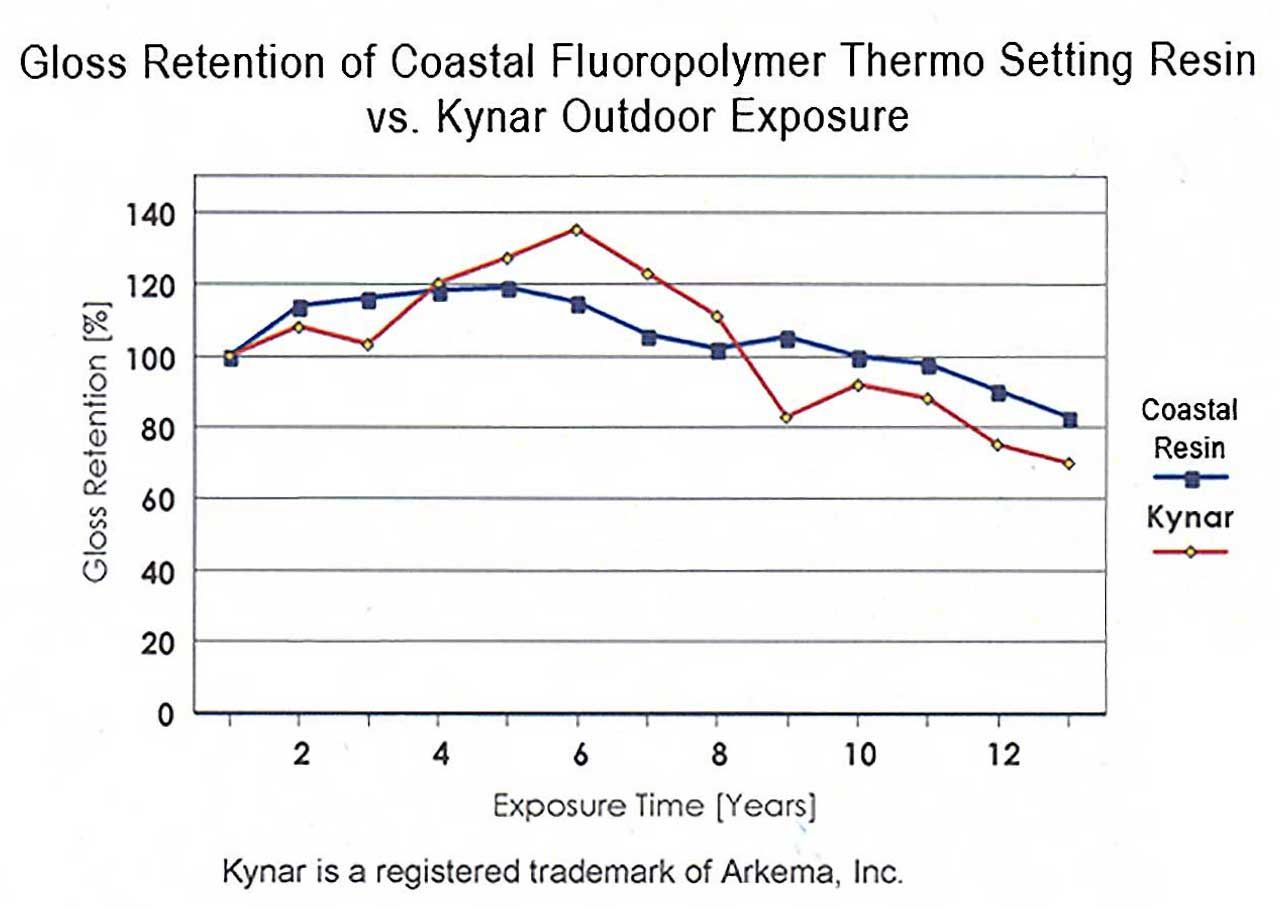
- Gloss and color retention: in outdoor exposure testing, Coastal’s resin held its gloss more steadily than Kynar over 13 years.
- A harder finish: it resists scratching and marring during fabrication, assembly and installation, when most damage happens.
- One coat: apart from a few highly chromatic colors, it needs a single coat where PVDF typically needs two.
- The same design range: custom colors and finishes, just as with PVDF.
What to put in the spec
- Name the AAMA level. 2604 suits most exteriors; 2605 is the call for coastal, high-rise and signature work.
- Ask about pretreatment. Even the best coating fails on poorly prepared metal. Why pretreatment matters more than powder vs. liquid.
- Ask for test results. A finisher should be able to show the coating’s results against the spec, like ours for Coastal Fluoropolymer.
Working on a project? Send us the drawings and we’ll recommend a system.
Resources
From the shop floor
What architects and fabricators ask us most about coatings, finishes and specifications.
Our coating systems
Powder coating vs. liquid coating
How the two compare on architectural aluminum, and why pretreatment matters more than either.
Read more
Architectural metal coatings: a primer for architects
AAMA 2603, 2604 and 2605 explained, and how fluoropolymers compare with Kynar.
Read more
What is a thermosetting fluoropolymer?
What the name means, how it differs from PVDF, and why architects specify it.
Read more
Interested in partnering with us?
Contact our team for pricing or to schedule an onsite visit of our facility. We usually reply within a couple of hours on business days.